
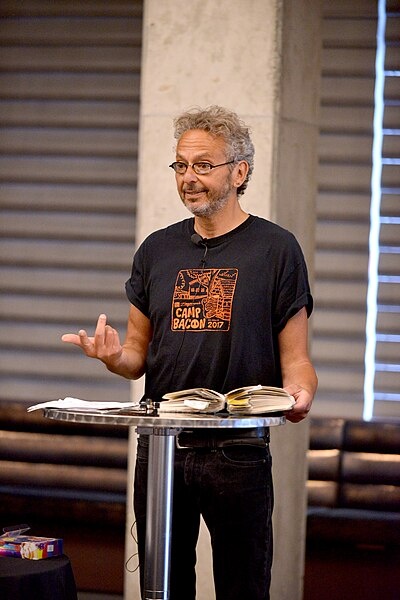
“If you teach people to hide their fears, the leader stops being a person. That’s the problem.”
— Ari Weinzweig, Co-founder, Zingerman’s
The Scene You Can’t Miss When Talking About Ari Weinzweig
March 1982, Ann Arbor, Michigan. Ari Weinzweig and Paul Saginaw opened a delicatessen with a $20,000 bank loan. It was in an old historic building near Ann Arbor Farmers Market. The young man who studied Russian history never grandly explained why he opened a sandwich shop. He simply did it.
Zingerman’s Delicatessen could have remained a neighborhood store. Most people around would have seen it that way. But that one shop grew into an enterprise group called Zingerman’s Community of Businesses. Multiple food-related businesses clustered around Ann Arbor. In 1999, zingermans.com spun off as an independent business. The story that started with one deli spread far and wide.
He wrote books too. “Zingerman’s Guide to Giving Great Service” and “A Lapsed Anarchist’s Approach to the Power of Beliefs in Business.” The titles alone speak volumes. Not many people put ‘a lapsed anarchist’s approach’ in a business book title. In 2006, the James Beard Foundation recognized him as part of “Who’s Who of Food & Beverage in America,” and the following year Bon Appétit awarded him a lifetime achievement award. For someone who started with $20,000, he’s come quite far.
Three Core Brand Philosophies
Choice Always Lives Within Me
Ari Weinzweig said, “It’s important to consciously recognize that we are making choices all day long.” This wasn’t a motivational quote. It was how he actually ran his organization. Zingerman’s didn’t teach employees to memorize rules. Instead, they talked about why the work mattered. The organizational culture was designed on the premise that the power of choice belongs to the individual, not the organization. He built that level of philosophical foundation into running a single store.
An Organization That Doesn’t Hide Fear
He said, “There’s this idea that great leaders don’t know fear, but if you teach people to hide their fear, the leader starts to look superhuman.” At Zingerman’s, a leader’s fear wasn’t taboo. A culture that acknowledges uncertainty—that’s one reason this organization could take root in Ann Arbor, a small city, for decades. He showed through action that an organization that doesn’t pretend to be perfect actually endures longer.
Service Starts With Employees
Ari Weinzweig consistently emphasized creating great organizational culture, providing great service to employees, and how difficult that work is. The logic is simple: to give good service to customers, the people doing the work must first be treated well. He wrote about this idea in a book, spoke about it in lectures, and applied it to actual business operations. The reason Zingerman’s Delicatessen became known as something more than a deli was because of that order of priority.
Soulpapa Marketing’s Perspective
Ari Weinzweig studied Russian history. He also studied anarchism. Now he runs a delicatessen. By his own account, he’s a “lapsed anarchist.” Whether that “lapsed” part is accurate, I’m not sure.
In 1982, he opened a door in Ann Arbor with $20,000. Over 40 years have passed. Now there are ten business entities. All in the same city. He didn’t expand to New York or Chicago. He didn’t expand so much as deepen.
He personally tastes everything they sell. It’s not a rule—it’s a habit. He eats before he sells. That order has never reversed. It means something comes before marketing. I sometimes think that trust is built before it’s explained.
He writes down his vision. Shares it with every employee. Not goals in numbers, but a picture in sentences. Opens the books completely too. They call it open-book management. The attitude seems to be that not hiding and trusting are the same thing.
Ari has said many times why he didn’t expand beyond Ann Arbor. Boiled down, it’s this: he chose to get better where he was, rather than spread something good thinly. A man who studied anarchism ultimately took root in one city. That’s what’s interesting.
References
- Ari Weinzweig — Wikipedia — Wikipedia
- A Lapsed Anarchist’s Approach to the Power of Beliefs in Business — Zingerman’s Press
- Zingerman’s Guide to Giving Great Service — Zingerman’s Press
- Who’s Who of Food & Beverage in America — 2006 — James Beard Foundation
Frequently Asked Questions
What conditions did Ari Weinzweig face when he founded the delicatessen in 1982?
In March 1982, Ari Weinzweig and Paul Saginaw opened Zingerman’s Delicatessen in Ann Arbor, Michigan with a $20,000 bank loan in an old historic building near Ann Arbor Farmers Market. The young man who studied Russian history started a sandwich shop, which became the starting point for what would eventually grow into a complex business enterprise.
When did Zingerman’s start its online business?
In 1999, zingermans.com spun off as an independent business entity. This was when the business that started with a single delicatessen began to seriously expand through online channels and became an important turning point in forming Zingerman’s Community of Businesses.
What is the most distinctive characteristic in the organizational culture that Ari Weinzweig pursues?
The core of Zingerman’s organizational culture is acknowledging leaders’ fears. Ari Weinzweig emphasizes that ‘if you teach people to hide their fears, the leader stops being a person,” and believes that a culture that acknowledges uncertainty is one reason the organization has taken deep root in Ann Arbor for decades.
Original Korean: https://soulpapa.co.kr/2026/03/10/ceo-interview-zingerman-s-2026-03-10/
Insights from Soulpapa Marketing — Korea’s digital marketing agency.